
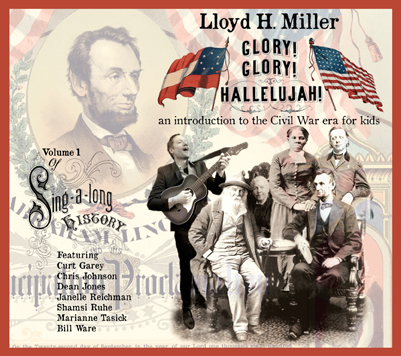
Sing-a-Long History Volume 1: Glory! Glory! Hallelujah! (Civil War Era)
As Introduction to the Civil War Era for Kids
My mom taught me so many songs as a child and I still associated many versions of songs that had parodies or various versions that made its way through history. Apparently, before we had a ‘Weird Al’, there was always someone around to mold and create popular songs into new that are sometimes just as popular as the original! In fact, when I first saw this album titled Glory! Glory! Hallelujah! I immediately thought of “The Battle Hymn of the Republic” parody version that my mom shared with me at a very early age. You know about this, right? It starts off…
“Mine eyes have seen the glory of the burning of the school…..”
Yeah, not exactly what Julia Ward Howe had in mind when she penned her version! All joking aside, Howe wasn’t even the first person to write a version of this song. The interesting journey as to how this song came about has a timeline that started well before the Civil War although many Americans today will hear the music and immediately recognize it as a patriotic song.
Timeline of Glory! Glory! Hallelujah! -Momma’s Bacon history lesson
“Glory, Hallelujah” was thought to be invented around camp meetings in the early 1800s in the southern US and had the lyrics of “Oh! Brothers will you meet me(3X)/On Canaan’s happy shore?” This early version had quite a different tune, was entirely religious and eventually became “Glory! Glory Hallelujah!” which was popular all across the United States by the 1850s. By the time the Civil War broke out, a new version called “John Brown’s Body” (of Harper’s Ferry fame) is traced to Fort Warren outside of Boston where an apparent soldier with the same name was not exactly a shining example of a soldier, often appearing late to fall on company line and became an inspiration (how can the man have the same name of THE great John Brown? sort of ribbing) to a new version that the solders were quite proud of singing. This version had the “Oh! Brothers” tune and the “Glory, Hallelujah” chorus and talked about how John Brown, the war hero who fought for Civil Rights, was dead but his ‘soul was marching on’. I imagine singing this version was of great comfort to those who joined the military for the Union after the war broke out and was sung with much gusto by the “Tiger Battalion” and was prepared for publication. Soldiers would sing this version at events and public reviews at many events in the northeastern United States and, since the tune and chorus were already popular, it was a familiar tune to all who heard it and easy to remember.
Now, interestingly enough, this song was to get another version due to a woman named Julia Ward Howe who was present during a public review of troops in Upton Hill, VA who were being dispatched to Murray, Kentucky. In 1861, Howe spent the night outside of Washington D.C. after witnessing the review and, in the middle of the night, woke up to scribble her new lyrics to what she called “The Battle Hymn of the Republic”. So while there were, by now, many versions of “John Brown’s Body” floating around, mostly with Civil War troops, Howe’s version got a popularity boost when it was featured in The Atlantic Monthly in February 1862. While many versions of the song exist, it is still popular in American culture and is used at both Republican and Democratic national conventions and sung at Presidential inaugurations. That is definitely a long way from the song’s start at southern camp meetings!
Connecting History through Song
Songs have always been used to tell stories about the times and Lloyd H. Miller (Deedle Deedle Dees) has long been exploring American history through his own albums. April 2015 marks the 150th anniversary of the end of the Civil War (April 1865), I think it is important to explore subjects like the effects of slavery, soldiers of the war, American leadership to a reciting on the “Gettysburg Address” to understand the power behind Lincoln’s words. Miller is providing a PDF download on the history behind each of the songs on this CD as a curriculum guide that will be available in April at http://www.lloydhmiller.com. As someone who thinks it is important to learn about history, especially our own country’s history, I love what Miller is doing to inspire kids to get their knowledge from reading and listening about our history is a wonderful gift.
Track Listing:
- John Brown
- Follow The Drinking Gourd
- Marching Through Georgia
- Trapped In The Attic
- Baldy
- Tenting On The Old Campground
- Weeksville
- Henry Box Brown
- Keep The Hate Mail Comin’
- O Captain! My Captain!
Sing-a-Long History Volume 1: Glory! Glory! Hallelujah! (Civil War Era)
List Price: $ 10.00
 Momma's Bacon